
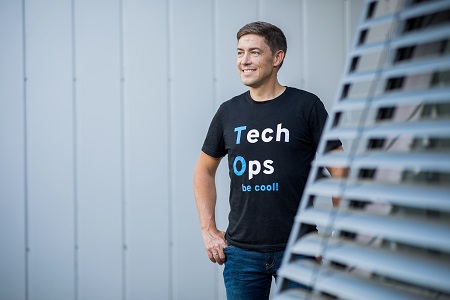
Stefan Mink, Sr Director TechOps Data Center & Bare Metal at IONOS
Artificial Intelligence isn’t just becoming a standard business tool; in 2026 it’s becoming the default engine behind everything from customer service to financial modelling. But as AI scales, its hidden cost is coming into focus: an extraordinary surge in electricity demand. As AI models become more complex and their use more widespread, the infrastructure required to run them is placing unprecedented strain on energy systems, creating a direct conflict with global sustainability goals.
The energy reality behind AI
The core of the issue is not simply the efficiency of data centres themselves. While factors such as Power Usage Effectiveness (PUE), cooling and renewable energy remain important, even the most efficient data centre cannot eliminate the energy demand created by increasingly intensive AI workloads.
The real opportunity therefore lies further up the technology stack: making AI models and the infrastructure running them fundamentally more energy-efficient.
According to the International Energy Agency (IEA), a typical AI data centre already consumes as much power as 100,000 households. As AI adoption accelerates, businesses face a difficult balancing act: capturing the benefits of innovation while managing rising energy consumption and meeting increasingly demanding Environmental, Social, and Governance (ESG) expectations.
The answer is not to slow innovation, but to make the underlying technology more efficient.
More efficient AI models
One of the most significant developments is the growing use of Mixture-of-Experts (MoE) architectures. Rather than activating an entire model for every request, MoE systems can selectively activate only the parts of the model required for a particular task.
In some cases, less than 5% of the model may be active for an individual request. In other words, as AI models become larger, the amount of computation required for each interaction does not necessarily have to increase proportionally.
This is an important shift in thinking about AI sustainability. Efficiency is no longer solely a question of how efficiently a data centre uses electricity; it is also about how much computation the AI model actually needs to perform the task.
For businesses, this means that choosing and deploying models based not only on capability but also on computational efficiency could become an increasingly important part of their sustainability strategy.
Another essential stream for optimizing inference is numerical format optimization, such as quantization. By representing model weights and activations using lower precision formats—moving from standard 32-bit floating-point numbers down to 8-bit or even 4-bit representations—models significantly reduce their memory footprint and processing overhead without sacrificing substantial accuracy.
More efficient AI infrastructure
The second major opportunity is the hardware and infrastructure used to run AI, particularly during inference, the process of using trained models to generate responses and perform tasks.
The industry is increasingly moving beyond a one-size-fits-all reliance on conventional GPUs. Specialised AI accelerators and inference-focused architectures are being developed to deliver greater performance with less energy.
The emergence of companies such as Groq illustrates this direction. Groq was founded by engineers behind Google’s Tensor Processing Unit (TPU) and developed specialised Language Processing Units (LPUs) designed specifically for fast and efficient AI inference. That architectural lineage traces directly back to the purpose-built infrastructure Google created for its own AI workloads.
Nvidia’s $20 billion agreement to license Groq’s inference technology and bring across its engineering leadership is the largest deal in the company’s history. It signals how strategically important this shift has become. The direction of travel is clear: AI infrastructure is evolving to become increasingly specialised, with energy efficiency becoming an important consideration alongside raw computing performance.
This could ultimately have a much greater impact on AI’s energy footprint than improvements to PUE alone. The objective should be to reduce the amount of energy required to perform useful AI computation in the first place.
The role of the data centre
This does not make data-centre efficiency irrelevant. Renewable energy, advanced cooling, efficient power management and well-designed facilities remain essential components of a sustainable AI ecosystem.
Direct Current (DC) power distribution is gaining traction as a key facility-level optimization. By supplying DC power directly to high-density AI racks and eliminating multiple redundant AC-to-DC conversion stages, data centres can significantly reduce electrical conversion losses, lower heat generation, and deliver power more efficiently to intensive AI hardware.
Liquid cooling can help manage the substantial heat generated by high-density AI hardware, while renewable energy can reduce the carbon intensity associated with the electricity that AI infrastructure consumes.
PUE remains a useful measure of how efficiently a facility delivers power to its IT equipment. But it should be viewed in context. A highly efficient data centre can still have a substantial environmental footprint if the AI workloads running inside it demand enormous amounts of electricity.
The sustainability conversation therefore needs to move beyond asking how efficiently we operate data centres and towards asking how efficiently we perform AI computation.
Transparency and ESG accountability
As ESG expectations and reporting requirements become more stringent, transparency will remain essential. Businesses need to understand and be able to demonstrate the environmental impact of their digital operations.
That means looking beyond headline data-centre metrics and asking cloud and technology providers for a more complete picture: where energy comes from, how much is consumed, how efficiently workloads are processed and what hardware and models underpin those workloads.
The future of sustainable AI will therefore not be determined by any single intervention. Renewable energy and efficient data centres matter, but so do smaller and more efficient models, specialised AI accelerators and infrastructure designed specifically for inference.
The goal is not to put the brakes on AI innovation. It is to make every unit of computation count.
By combining cleaner energy with more efficient models and increasingly specialised AI infrastructure, businesses can build an AI ecosystem in which technological progress and environmental responsibility reinforce rather than undermine one another.

