


Brendan Thorpe, Customer Success Manager at Auriga
For most of their history, bank branches and ATMs have existed to serve a single purpose: to give customers a physical place to carry out financial transactions. That premise has been quietly dismantled over the past decade. Routine banking transfers, balance checks, and bill payments now happen on a device that fits in a pocket. What remains in the physical estate is a different kind of need, defined by complexity, sensitivity, and the moments when customers want a conversation rather than a confirmation screen.
Branches and ATMs are not disappearing, but they are being asked to justify their existence in entirely new terms. Institutions that treat this as a cost-reduction exercise are missing the point, whereas those that see it as a design challenge are moving in the right direction.
When digital sets the standard
Digital adoption has done something more subtle than simply reducing branch footfall. It has raised the bar for every interaction, physical or digital. Customers who manage their finances through a well-designed app bring those expectations with them when they visit a branch or use an ATM.
They expect continuity: to pick up where they left off, without repeating themselves.
Meeting that expectation requires physical channels to be woven into the same data fabric as digital ones, not bolted on as an afterthought. The purpose of the physical channel is to handle what digital cannot: nuance, complexity, and the human element.
The ATM reimagined
The cash machine was, for a long time, a remarkably stable piece of infrastructure. Its core function, dispensing banknotes in exchange for a PIN, barely changed for decades. What is happening now is a more fundamental reimagining of what an unattended terminal can do.
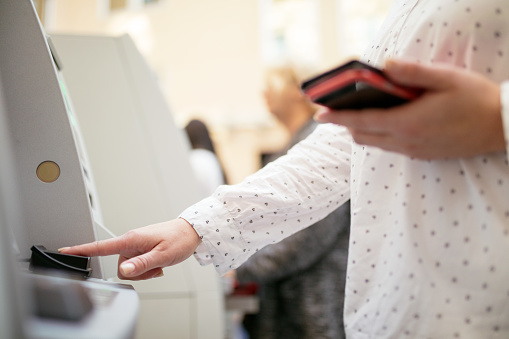
Newer deployments support account services, person-to-person transfers, and credit facilities, tasks that once required a branch visit or a digital session. As branches close or reduce hours, the machines left behind must absorb more of the service load. The ATM is becoming, in effect, a branch in a box: compact, always available, and capable of handling the kind of banking customers once queued for at a counter.
Less space, more intelligence
Shrinking the branch does not shrink the service obligation. A bank moving to a smaller, lighter-touch format still needs to deliver the same everyday banking, it simply has fewer staff to do so. That gap must be filled by technology, and filling it adequately requires a genuine step change in self-service capability.
A new generation of ATM installations now functions almost as staffed counters, processing complex deposits, offering video-assisted transactions, and integrating with back-end systems in real time. These machines also generate richer operational data on usage patterns, peak demand, and failure points, that feeds smarter decisions about how the wider network is managed. Flexibility in ATM capability, adapted to local needs rather than imposed from a single global template, is increasingly a competitive differentiator.
Security and convenience, finally aligned
The physical card has always been the weak point of ATM security, acting simultaneously as the authentication credential and the most obvious target for criminals. Techniques for copying and exploiting card data have evolved continuously, and hardware hardening alone has never fully closed that gap. Moving to contactless or app-based access changes the equation.
When authentication happens through a device secured by biometrics or multi-factor verification, the card disappears from the attack surface entirely. The experience improves too, as pre-staging a cash collection from a mobile app and collecting it at a terminal without touching a keypad is faster and reduces the time spent in an exposed position at a machine. Security and convenience, in this case, point in the same direction.
The case for shared infrastructure
One of the structural inefficiencies in today’s ATM landscape is that machines remain largely tied to the institution that owns them. A customer wanting to deposit cash must find a terminal operated by their own bank, an increasingly difficult task as proprietary networks shrink. Opening deposit functionality across institutional boundaries changes this dynamic. A shared network means any compliant terminal becomes a potential service point for any customer, increasing utilisation and making it easier to justify maintaining coverage in locations no single bank could serve alone economically.
It is the same logic that has driven shared withdrawal networks across several European markets, where the ecosystem is worth considerably more as a collective resource than as a collection of competing proprietary assets.
What 2026 will accelerate
Several threads are converging this year with lasting implications. Industry-wide ATM fleet migrations to modern operating systems are establishing a new security baseline, though the transition briefly opens windows that sophisticated attackers are already probing.
Artificial intelligence is moving into the mainstream of cash operations as a practical tool for demand forecasting and anomaly detection, replacing the fixed replenishment schedules that have long made cash logistics unnecessarily costly.
Zero Trust principles are being embedded more deeply into ATM network architecture, rebuilding the assumption of trust from the ground up. At the same time, the organisational divide between digital and physical channel management, long a source of strategic incoherence, is under real pressure to dissolve. Banks that use 2026 to finally integrate these agendas, rather than running them in parallel, will be best placed to compete in the years ahead.